
Kenya

Mount Kenya

When to visit
January to February and September to October
Size
715 sq km
Temperature
18 'C
Rainfall
20mm
Age requirement
12 Year

Overview

About Mount Kenya

Mount Kenya is Africa’s second highest mountain, an extinct stratovolcano rising to 5,199 metres at Batian, and a UNESCO World Heritage Site covering 715 square kilometres of national park.

Unlike Kilimanjaro, the true summits of Batian and Nelion require technical climbing. The trekking peak is Point Lenana at 4,985 metres, reached without ropes and climbed by the great majority of visitors over four to five days.

The mountain passes through remarkable zones on the way up: farmland, montane forest, bamboo, giant heather, and finally the Afro-alpine moorland of giant lobelia and groundsel that gives the upper mountain its extraordinary appearance.

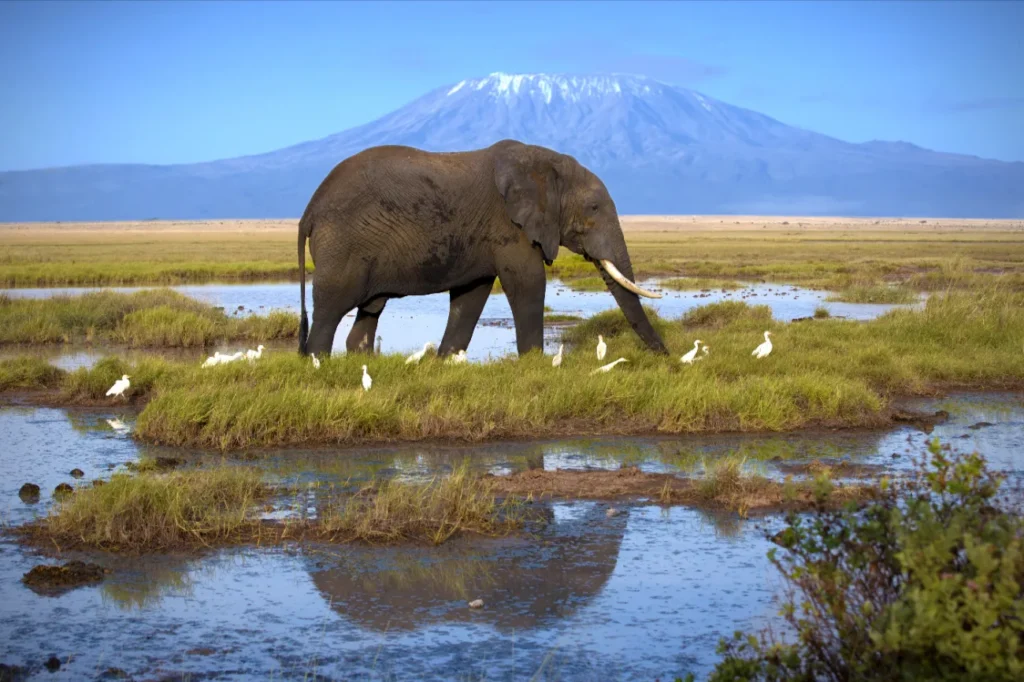
Glaciers still cling to the summit area, though they have retreated dramatically and are expected to disappear within decades. The lower forest holds elephant, buffalo, black-fronted duiker and colobus, making the approach a wildlife experience in itself.
People and culture

People and culture

Mount Kenya is sacred to the Kikuyu, who call it Kirinyaga and regard it as the dwelling place of Ngai, the creator. Traditional homesteads were oriented to face the peaks, and the mountain remains central to Kikuyu identity.

The Ameru and Embu peoples farm the eastern and southern slopes and hold their own traditions connected to the mountain, and the fertile volcanic soils of the lower slopes support some of Kenya's most productive smallholder agriculture, particularly tea and coffee.

The mountain gave Kenya its name, and its image appears on the national coat of arms. It was also a refuge for Mau Mau fighters during the 1950s uprising, along with the neighbouring Aberdares.

Guides and porters on the mountain come overwhelmingly from the surrounding communities, and trekking is a significant source of employment in Naro Moru, Nanyuki and Chogoria.

Getting there

How to get there

Weather

Weather and climate in Mount Kenya

Mount Kenya spans an enormous altitude range, from around 1,600 metres at the forest boundary to 5,199 metres at the summit, and conditions change completely as you climb. At the trailheads days reach 20°C to 25°C and nights fall to around 10°C.

Month by month

High and low temperature and rainfall, shaded by how good the month is for a safari.

  • Jan

    26° / 10°

    45 mm

  • Feb

    27° / 10°

    45 mm

  • Mar

    26° / 11°

    90 mm

  • Apr

    24° / 12°

    190 mm

  • May

    23° / 12°

    140 mm

  • Jun

    22° / 10°

    45 mm

  • Jul

    21° / 9°

    25 mm

  • Aug

    22° / 9°

    30 mm

  • Sep

    24° / 10°

    35 mm

  • Oct

    25° / 11°

    60 mm

  • Nov

    24° / 12°

    150 mm

  • Dec

    25° / 11°

    80 mm

  • Excellent
  • Very good
  • Good
  • Fair
  • Avoid

Above 4,000 metres the picture is entirely different. Nights fall well below freezing, and the summit area holds permanent ice, though the glaciers have retreated dramatically and are expected to vanish within decades.

Rain falls in two seasons, March to May and October to December, with the south-eastern slopes catching considerably more than the north. The mountain generates its own weather, and afternoon cloud is the norm even in the dry months.

The practical pattern is consistent: clear mornings, cloud building from late morning, and clearing again at dusk. Trekkers who start early see the peaks; those who start late frequently do not.

The pattern is consistent through the year: clear mornings, cloud building from late morning, and clearing again at dusk, so trekkers who start early see the peaks and those who start late frequently do not.

Best time to go

Best time to visit Mount Kenya

Best months
Jan–Mar, Jun–Oct, Dec

Mount Kenya has two clear climbing windows, and they are the same as Kilimanjaro's for the same reason.

January to February is the driest and most reliable period, with the clearest views and the firmest trails. The rock on the technical routes is also in its best condition, which matters for anyone attempting Batian or Nelion.

July to September is the second dry window and the busiest, coinciding with the northern summer holidays. Conditions are good though the mountain can be colder and windier than in the January window.

March to May and October to December bring the rains, when trails become muddy and slippery, cloud sits on the mountain for days, and the summit is frequently invisible. Trekking remains possible but is considerably harder.

Whichever window you choose, allow at least four days and preferably five. Rushing the ascent is the single most common cause of failure on Point Lenana.

Whichever window you choose, allow at least four days and preferably five. Rushing the ascent is the single most common cause of failure on Point Lenana, and the extra day improves both success rates and enjoyment considerably.

Things to do

Things to do in Mount Kenya

  1. Point Lenana Trek

    Sirimon · Chogoria · Naro Moru

    The 4,985-metre trekking summit, reached over four to five days.

  2. Technical Climbing

    Batian · Nelion

    The true summits at 5,199 metres, requiring rock and ice skills.

  3. Afro-Alpine Moorland

    Upper Mountain

    Giant lobelia and groundsel above 3,500 metres, found nowhere else.

  4. Chogoria Route

    Eastern Approach

    Widely considered the most scenic route, past Lake Michaelson.

  5. Montane Forest Wildlife

    Lower Slopes

    Elephant, buffalo, colobus and black-fronted duiker in dense forest.

  6. Mount Kenya Glaciers

    Summit Area

    Retreating ice fields expected to disappear within decades.

FAQ

Frequently asked questions

Do I need climbing experience for Mount Kenya?

Not for Point Lenana at 4,985 metres, which is a trekking peak reached without ropes or technical skill over four to five days, and which the great majority of visitors climb. The true summits of Batian and Nelion at 5,199 metres are a different matter entirely, requiring genuine rock and ice climbing ability and usually a specialist guide. Most itineraries target Lenana. Guides, porters and hut bookings are arranged through operators based in Nanyuki, Naro Moru or Chogoria.

How does Mount Kenya compare with Kilimanjaro?

Mount Kenya is lower, considerably quieter and generally regarded as more beautiful, with dramatic jagged peaks rather than Kilimanjaro's broad volcanic dome and a far richer Afro-alpine flora. It is also cheaper and less crowded. Kilimanjaro is higher and its summit is reachable by trekking, which Mount Kenya's true summit is not. Many climbers use Mount Kenya as acclimatisation before Kilimanjaro. Huts fill during the January and August peaks, so arrangements should be made well in advance.

Which route should I take?

Sirimon from the north-west is the driest and offers gentle acclimatisation. Chogoria from the east is widely considered the most scenic, passing Lake Michaelson and the Gorges Valley. Naro Moru from the west is the fastest but includes the notorious vertical bog and has lower success rates because it gains height too quickly. Many operators ascend Sirimon and descend Chogoria. Many climbers use Mount Kenya as acclimatisation before attempting Kilimanjaro across the border.

How long does the trek take?

Four to five days for Point Lenana, and five is much the better choice. The extra day allows proper acclimatisation and substantially improves both success rates and enjoyment. Three-day itineraries exist and are best avoided, as they gain height too fast and leave little margin if weather or altitude sickness intervenes. Summit day starts around two in the morning. Guides, porters and hut bookings are arranged through operators based in Nanyuki, Naro Moru or Chogoria.

Is altitude sickness a problem?

It is the main reason people fail to reach Point Lenana. At 4,985 metres the air holds roughly half the oxygen of sea level, and ascending too quickly causes headaches, nausea and worse. Choose a five-day itinerary, walk slowly, drink plenty of water and tell your guide immediately about symptoms. Descending is the only reliable treatment, and guides are trained to insist on it. Huts fill during the January and August peaks, so arrangements should be made well in advance.

When is the best time to climb?

January to February is the driest and most reliable window, with the clearest views and firmest trails, and the best rock conditions for technical routes. July to September is the second dry window and the busiest. March to May and October to December bring the rains, when trails become muddy, cloud sits on the mountain for days and the summit is frequently invisible. Many climbers use Mount Kenya as acclimatisation before attempting Kilimanjaro across the border.

What wildlife will I see?

The lower forest holds elephant, buffalo, black-fronted duiker, bushbuck and colobus monkey, and trekkers on the forest sections occasionally encounter them, which is why an armed ranger accompanies some routes. Above the treeline mammals are scarce, though rock hyrax are common around the huts. The Afro-alpine flora is the real attraction at altitude rather than the fauna. Guides, porters and hut bookings are arranged through operators based in Nanyuki, Naro Moru or Chogoria.

Where do I stay on the mountain?

Mountain huts and bandas serve the main routes, with bunk accommodation at Old Moses, Shipton's, Mackinder's and Minto's depending on which way you go, and camping is also permitted. Facilities are basic and unheated. Bookings are handled by your operator, and huts fill during the January and August peaks, so arrangements should be made well in advance. Huts fill during the January and August peaks, so arrangements should be made well in advance.

Explore other destinations

All destinations