
Tanzania

Mount Meru

When to visit
January to February and June to October
Size
552 sq km
Temperature
24 'C
Rainfall
20mm
Age requirement
12 Year

Overview

About Mount Meru

Mount Meru rises to 4,566 metres immediately north-east of Arusha, making it Tanzania’s second highest mountain and the fifth highest in Africa.

It is a dormant stratovolcano whose eastern side collapsed in a massive eruption some 8,000 years ago, leaving a horseshoe crater open to the east with a near-vertical inner wall and an ash cone rising from the floor.

The standard route follows the crater rim itself, a dramatic ridge walk with the drop falling away on one side and views across to Kilimanjaro on the other, which many trekkers consider more spectacular than the larger mountain.

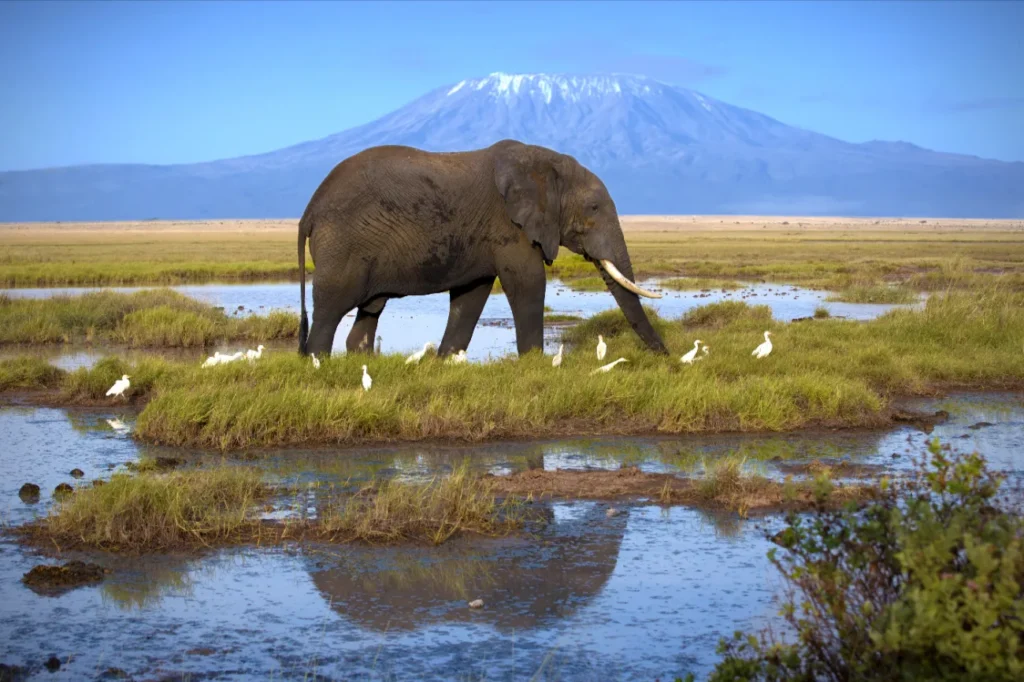
Meru lies within Arusha National Park, so the lower slopes hold genuine wildlife. An armed ranger accompanies every group, and giraffe, buffalo and colobus are commonly seen on the first day’s walk through the forest.
People and culture

People and culture

The Meru people farm the fertile southern and eastern slopes, growing coffee and bananas on volcanic soil that supports one of the most densely settled rural areas in Tanzania.

The mountain gives the community its name, and cultural tourism programmes at Ilkiding'a, Ng'iresi and Mulala on its slopes are among the oldest in the country, offering village walks, farm visits and cooking with local families.

The Maasai graze the drier plains to the north and east, and the two communities have a long history of trade and periodic friction over land and water in the foothills.

Guides and porters come from the villages around the mountain, and because Meru sees a fraction of Kilimanjaro's traffic, the trekking economy here is smaller and the experience correspondingly less commercial.

Getting there

How to get there

Weather

Weather and climate in Mount Meru

Mount Meru spans from around 1,500 metres at the park gate to 4,566 metres at Socialist Peak, and conditions change completely across that range. At the base days reach 22°C to 27°C with nights around 12°C.

Month by month

High and low temperature and rainfall, shaded by how good the month is for a safari.

  • Jan

    26° / 13°

    55 mm

  • Feb

    27° / 13°

    60 mm

  • Mar

    26° / 14°

    150 mm

  • Apr

    24° / 14°

    250 mm

  • May

    23° / 13°

    160 mm

  • Jun

    23° / 11°

    30 mm

  • Jul

    22° / 10°

    20 mm

  • Aug

    23° / 10°

    20 mm

  • Sep

    25° / 11°

    20 mm

  • Oct

    26° / 13°

    45 mm

  • Nov

    25° / 14°

    150 mm

  • Dec

    26° / 13°

    90 mm

  • Excellent
  • Very good
  • Good
  • Fair
  • Avoid

Higher up the picture alters sharply. Saddle Hut at 3,570 metres is cold, and summit night on the crater rim frequently falls below freezing with significant wind exposure along the ridge.

Rain follows the northern Tanzania pattern, with long rains from March to May peaking in April and short rains through November. The southern slopes catch considerably more moisture, which is why the forest belt is so dense.

The mountain generates cloud through the middle of most days. Kilimanjaro is visible from the summit ridge at dawn on clear mornings and usually hidden by nine, which is one reason summit attempts start around two in the morning.

The mountain generates cloud through the middle of most days, so views open and close quickly and photography rewards being out early rather than waiting for better light later on.

Best time to go

Best time to visit Mount Meru

Best months
Jan–Feb, Jun–Oct, Dec

Meru's climbing seasons mirror Kilimanjaro's, since the two mountains share a weather system.

June to October is the main dry window and the most reliable for trekking, with firm trails and the best chance of clear views across to Kilimanjaro from the summit ridge.

December to February is the second window, warmer and often clearer than mid-year, and noticeably quieter on the mountain.

March to May brings the long rains, when the forest sections become slippery and the crater rim genuinely exposed in bad weather. Trekking is possible but considerably harder, and views are frequently lost.

Many climbers use Meru deliberately as acclimatisation before Kilimanjaro, in which case the timing follows the Kilimanjaro booking rather than Meru's own conditions. Three or four days here materially improves summit odds on the larger mountain, and the two are easily arranged through a single Arusha operator.

Many climbers use Meru deliberately as acclimatisation before Kilimanjaro, in which case the timing follows the Kilimanjaro booking rather than Meru's own conditions. Three or four days here materially improves summit odds on the larger mountain, and the two are easily arranged through a single Arusha operator.

Things to do

Things to do in Mount Meru

  1. Socialist Peak

    Crater Rim

    The 4,566-metre summit, reached along a dramatic crater rim ridge.

  2. Crater Rim Ridge Walk

    Summit Approach

    A knife-edge ridge above the collapsed eastern crater wall.

  3. Kilimanjaro Sunrise

    Summit

    Kilimanjaro across the plain at dawn, before cloud closes in.

  4. Forest Wildlife

    Lower Slopes

    Giraffe, buffalo and colobus on the first day, with an armed ranger.

  5. Momella Lakes

    Park Floor

    Alkaline lakes below the mountain, with flamingo and waterbuck.

  6. Kilimanjaro Acclimatisation

    Full Route

    Widely regarded as the best preparation for climbing Kilimanjaro.

FAQ

Frequently asked questions

How hard is Mount Meru compared with Kilimanjaro?

Meru is lower at 4,566 metres but steeper and more sustained, with a genuinely exposed ridge walk along the crater rim on summit day. Kilimanjaro is higher and the altitude challenge is greater, but the walking itself is gentler. Many trekkers find Meru harder underfoot and more dramatic, while Kilimanjaro is harder physiologically. Meru is also considerably cheaper and far less crowded. Meru sees a fraction of Kilimanjaro's traffic, so huts are rarely full and the mountain feels genuinely quiet.

Is Meru good acclimatisation for Kilimanjaro?

It is widely considered the best available. Reaching 4,566 metres over three or four days prompts genuine physiological adaptation, and climbers who summit Meru before starting Kilimanjaro report markedly better success rates on the larger mountain. Allow a rest day between the two. The combination adds cost and time but substantially improves the odds of reaching Uhuru Peak. The trek starts inside Arusha National Park, so park fees apply on top of the climbing costs.

How long does the Meru trek take?

Three or four days, with four the more comfortable choice. The route climbs through forest to Miriakamba Hut, then to Saddle Hut at 3,570 metres, with summit night starting around two in the morning to reach Socialist Peak for sunrise. A fourth day allows an acclimatisation walk to Little Meru, which improves both comfort and summit success considerably. Most operators in Arusha run Meru as a standard three or four day package that pairs easily with a Kilimanjaro booking.

Why is an armed ranger required?

Because the lower slopes lie within Arusha National Park and hold buffalo, elephant and other large animals. Buffalo in particular are unpredictable and account for most dangerous encounters on the mountain. A ranger accompanies every group by regulation, which also means the first day's walk doubles as a genuine wildlife experience, with giraffe and colobus commonly seen. Meru sees a fraction of Kilimanjaro's traffic, so huts are rarely full and the mountain feels genuinely quiet.

What is the crater rim like?

It is the defining feature of the climb. Meru's eastern side collapsed in a huge eruption around 8,000 years ago, leaving a horseshoe crater with a near-vertical inner wall and an ash cone on the floor. The summit route follows the rim itself, narrow in places with a considerable drop, which is exhilarating in clear weather and demands care in wind or mist. The trek starts inside Arusha National Park, so park fees apply on top of the climbing costs.

When should I climb Mount Meru?

June to October is the main dry window and the most reliable, with firm trails and the best chance of seeing Kilimanjaro from the summit ridge. December to February is a second window, warmer and quieter. March to May brings the long rains, when the forest becomes slippery and the exposed crater rim is genuinely unpleasant in bad weather, with views usually lost. Most operators in Arusha run Meru as a standard three or four day package that pairs easily with a Kilimanjaro booking.

Where do I stay on the mountain?

Two mountain huts serve the route: Miriakamba at around 2,500 metres and Saddle Hut at 3,570 metres, both with bunk accommodation and basic facilities. This makes Meru simpler logistically than Kilimanjaro's camping routes, as no tents are required. Bookings are handled through your operator, and the huts are rarely full given how few people climb the mountain. Meru sees a fraction of Kilimanjaro's traffic, so huts are rarely full and the mountain feels genuinely quiet.

Can I see wildlife on the climb?

Yes, and more than most people expect. The first day passes through montane forest within Arusha National Park, where giraffe, buffalo, warthog, bushbuck and black-and-white colobus are all commonly encountered. Higher up the wildlife thins out, though rock hyrax are common around the huts. The Momella Lakes on the park floor add flamingo and waterbirds before or after the trek. The trek starts inside Arusha National Park, so park fees apply on top of the climbing costs.

Explore other destinations

All destinations