
Kenya

Tsavo East National Park

When to visit
January to February and June to October
Size
13,747 sq km
Temperature
31 'C
Rainfall
10mm
Age requirement
12 Year

Overview

About Tsavo East National Park

Tsavo East covers 13,747 square kilometres of semi-arid bush and open plain, and together with Tsavo West forms one of the largest protected areas in the world.

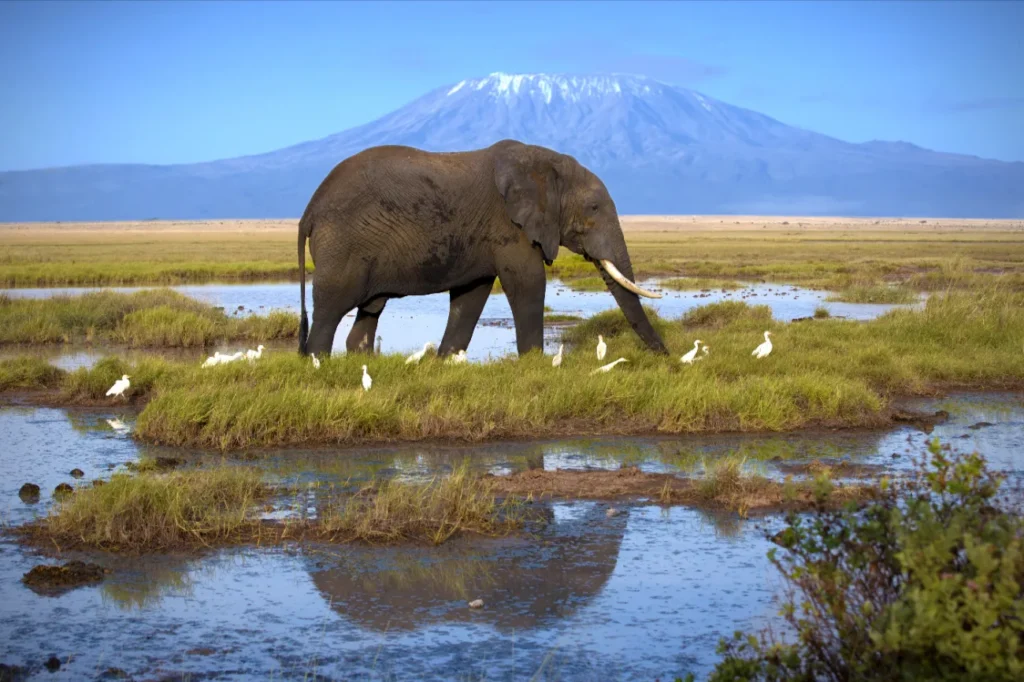
It is defined by red earth. The soil here stains everything it touches, and the park’s elephants, which dust-bathe constantly, take on a deep rust colour found nowhere else, giving Tsavo its famous red elephants.

The Galana River runs through the park and is its lifeline, drawing game through the dry season, while the Yatta Plateau, one of the longest lava flows in the world, runs for nearly 300 kilometres along its western edge.

Tsavo is wilder and emptier than Kenya’s northern parks. The bush is thick, sightings take patience, and the sense of scale is the point: you can drive for hours here without meeting another vehicle, which is increasingly rare in Kenya.
People and culture

People and culture

The Taita people farm the hills to the south-west of the park, and their terraced slopes and sacred forest groves are among the most distinctive cultural landscapes in southern Kenya.

The Waata, historically hunter-gatherers of this bush country, were displaced by the park's creation and by the criminalisation of hunting, and their knowledge of the landscape survives largely through oral tradition.

Tsavo's best-known story is a grim one. During the construction of the Uganda Railway in 1898, two male lions killed a large number of workers at the Tsavo River crossing before being shot, and the man-eaters of Tsavo remain part of the region's identity.

Community conservancies and ranches border the park, and several work with lodges on wildlife tourism, providing employment and a share of revenue in an area with few alternatives.

Getting there

How to get there

Weather

Weather and climate in Tsavo East National Park

Tsavo East is hot and semi-arid, sitting at around 200 to 700 metres, considerably lower and hotter than Kenya's highland parks. Days run between 26°C and 31°C and nights fall to 14°C to 18°C.

Month by month

High and low temperature and rainfall, shaded by how good the month is for a safari.

  • Jan

    30° / 15°

    50 mm

  • Feb

    31° / 15°

    45 mm

  • Mar

    31° / 17°

    90 mm

  • Apr

    29° / 18°

    180 mm

  • May

    28° / 17°

    90 mm

  • Jun

    27° / 15°

    20 mm

  • Jul

    26° / 14°

    10 mm

  • Aug

    27° / 14°

    10 mm

  • Sep

    29° / 15°

    15 mm

  • Oct

    30° / 17°

    40 mm

  • Nov

    29° / 17°

    150 mm

  • Dec

    29° / 16°

    90 mm

  • Excellent
  • Very good
  • Good
  • Fair
  • Avoid

Rain falls in two seasons. The long rains run March to May, peaking in April, and short rains fall through November. Annual rainfall is low at roughly 350 millimetres, and much of the park is thorn bush and open plain as a result.

The Galana River is what carries the park through the dry months, drawing elephant, buffalo and plains game to its banks as the surrounding bush dries out entirely. Aruba Dam serves the same function in the east.

Heat and dust are the practical considerations. The red soil lifts easily and the middle of the day can be genuinely hot, so game drives concentrate on early morning and late afternoon, with a long break between.

Game drives concentrate on early morning and late afternoon, with a long break through the middle of the day when the heat is fierce and animals are inactive in whatever shade they can find.

Best time to go

Best time to visit Tsavo East National Park

Best months
Jan–Mar, Jun–Dec

Tsavo East is a dry-season park, and the density of the bush makes that difference more pronounced than in open savanna.

June to October is the main dry season and the best window. The bush thins, game concentrates along the Galana River and at Aruba Dam, and sightings become far more likely. September and October are particularly good.

January and February form a second dry window, hot and clear, with similar concentrations of game and slightly fewer visitors than the mid-year peak.

March to May brings the long rains. The bush thickens dramatically and game disperses, making sightings hard work, though the landscape is green and birding is at its best.

November brings short rains that settle the dust and green the plains briefly. Whichever month, drive early and late, as the middle of the day is hot and animals are inactive.

Whichever month you visit, pick a stretch of the Galana and work it slowly rather than trying to cover distance. Tsavo East is vast, and patience along a single productive section produces far more than driving hard across the park.

Things to do

Things to do in Tsavo East National Park

  1. Red Elephants

    Galana River · Aruba

    Elephants stained deep rust by the park's red volcanic soil.

  2. Galana River Drives

    Galana River

    The park's lifeline, drawing game through the dry season.

  3. Yatta Plateau

    Western Boundary

    One of the world's longest lava flows, running nearly 300 kilometres.

  4. Lugard Falls

    Galana River

    Water forced through a narrow gorge of water-sculpted rock.

  5. Aruba Dam

    Eastern Sector

    A man-made dam drawing large concentrations of game and waterbirds.

  6. Mudanda Rock

    Near Voi Gate

    A rock outcrop above a natural dam, with elephant coming to drink.

FAQ

Frequently asked questions

Why are Tsavo's elephants red?

The soil. Tsavo's earth is a deep rust colour from volcanic minerals, and elephants dust-bathe constantly to protect their skin from sun and parasites, coating themselves in it. The effect is striking and unique to this ecosystem: the same animals would appear ordinary grey after heavy rain washes the colour off. It has become the park's defining image and the reason many photographers come here specifically. Voi and Sala gates both sit close to the Nairobi to Mombasa road, which makes access unusually straightforward for a park this size.

How big is Tsavo?

Enormous. Tsavo East covers 13,747 square kilometres on its own, and together with Tsavo West the combined area is around 22,000 square kilometres, making it one of the largest protected areas in the world and roughly the size of Wales. That scale is central to the experience: you can drive for hours without meeting another vehicle, which is increasingly rare anywhere in Kenya. Game viewing rewards patience here rather than distance, so pick a stretch of river and work it slowly.

Is Tsavo good for first-time safari visitors?

It depends what you want. The bush is thick, sightings take patience and predator densities are lower than in the Maasai Mara, so visitors expecting constant action may be disappointed. What Tsavo offers instead is scale, solitude and enormous elephant herds. It suits travellers who value wilderness over guaranteed sightings, and it works particularly well combined with a beach stay on the coast. Many itineraries pair Tsavo East with a beach stay on the south coast, which avoids backtracking to Nairobi entirely.

How do I get to Tsavo East?

The park sits on the main Nairobi to Mombasa road, so access is straightforward. Voi Gate is about 330 kilometres from Nairobi, roughly five hours, and around 160 kilometres from Mombasa. The Madaraka Express railway between the two cities passes along the park boundary, and game is sometimes visible from the train. Light aircraft also serve several airstrips within the park. Voi and Sala gates both sit close to the Nairobi to Mombasa road, which makes access unusually straightforward for a park this size.

What are the man-eaters of Tsavo?

In 1898, during construction of the Uganda Railway, two male lions killed a large number of workers at the Tsavo River crossing over several months before being shot by the engineer in charge. The story became famous worldwide and has been filmed repeatedly. The lions themselves are now displayed at the Field Museum in Chicago. The episode remains part of the region's identity. Game viewing rewards patience here rather than distance, so pick a stretch of river and work it slowly.

Can I combine Tsavo with the coast?

Very easily, and it is the standard Kenyan itinerary. Tsavo East lies between Nairobi and Mombasa, roughly three hours from Diani and the south coast beaches, so a two or three night safari slots neatly before or after a beach stay. Many operators sell the combination as a package, and it avoids the backtracking that a Maasai Mara and coast trip requires. Many itineraries pair Tsavo East with a beach stay on the south coast, which avoids backtracking to Nairobi entirely.

What is Lugard Falls?

It is a stretch of the Galana River where the water is forced through a narrow gorge of extraordinarily sculpted rock, worn smooth into curves and channels by centuries of flow. It is not a waterfall in the conventional sense but a series of rapids and chutes. Visitors may leave the vehicle at designated points, and crocodile are often visible in the pools below. Voi and Sala gates both sit close to the Nairobi to Mombasa road, which makes access unusually straightforward for a park this size.

When is the best time to visit?

June to October is the main dry season and the strongest window, when the bush thins and game concentrates along the Galana River and at Aruba Dam. January and February form a second dry window, hot and clear with slightly fewer visitors. March to May brings the long rains, when the bush thickens dramatically and game disperses, though birding is at its best and the landscape is green. Game viewing rewards patience here rather than distance, so pick a stretch of river and work it slowly.

Explore other destinations

All destinations